

Hydration Science · Family Springs Water
What pH 7.8 Actually Means for Your Body
The Fish Tank Nobody Talks About
Imagine you're keeping a saltwater fish tank. You've got the right food, the right temperature, the right lighting. Everything looks perfect. Then, over a few days, the pH in that tank shifts by just half a unit: from 8.0 to 7.5. You haven't changed anything you can see.
But something invisible has changed. Completely.
At pH 8.0, ammonia in the water is mostly harmless. At pH 7.5, that same ammonia becomes toxic, not because there's more of it, but because the drop in pH converted it into a form that attacks gill tissue. At the same time, the way oxygen binds and releases in the water changes. Ion transport through the fish's gills, the mechanism that lets them breathe at all, becomes impaired. The fish start to stress. Then they start to die.
The fish didn't change. The food didn't change. The temperature didn't change.
The chemistry of the water changed. And everything followed.
Research from aquatic biology has documented this for decades. A shift of 0.1 to 0.5 pH units can be the difference between a thriving ecosystem and a collapsing one. Environmental protection agencies use this as the foundation for why they regulate pH in rivers and lakes so tightly.
Your body is not so different.
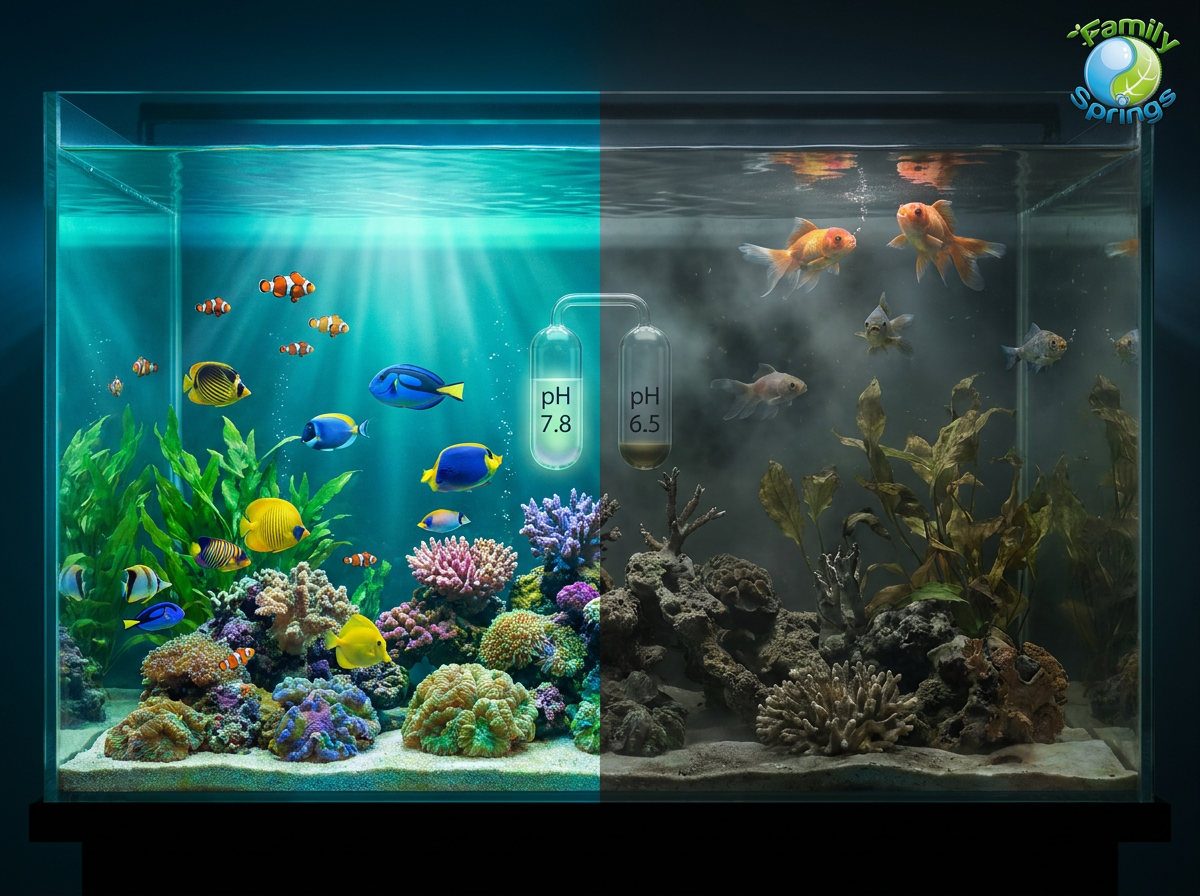
A 0.5-unit pH shift changes everything in an aquatic environment: dissolved gases, gill function, toxicity thresholds. The fish didn't change. The chemistry did.
pH Is Not a Number. It's a World.
Here's something most people don't realize: pH isn't a linear scale. It's logarithmic. That means each single unit represents a tenfold change in hydrogen ion concentration. A shift from pH 7 to pH 6 isn't a small step; it's a completely different chemical environment.
We tend to talk about pH like it's a measurement of how "acidic" or "alkaline" something is, as if it's the water equivalent of temperature, interesting to know but not particularly consequential. That's a mistake.
In every living system we've ever studied (ocean, soil, blood, cell), pH determines what chemistry is even possible. It controls whether enzymes work or shut down. It determines whether minerals are available or locked away. It decides whether proteins fold correctly or denature into uselessness.
To understand what pH 7.8 means for your body, you first have to understand that pH isn't a rating system. It's the rulebook.
What's Actually in pH 7.8
The pH of Family Springs water (7.8) isn't something added. It isn't a setting on a machine. It's the chemical fingerprint of what the water picked up as it moved through limestone formations for decades, maybe longer.
Here's what's in it:
The math per day: If you drink two liters of Family Springs water daily, you're getting approximately 64 mg of calcium, 7.2 mg of magnesium, and 164 mg of bicarbonate from that water alone. The WHO has acknowledged that dietary calcium and magnesium from drinking water can meaningfully contribute to daily mineral intake, particularly for populations who don't consume much dairy or magnesium-rich food.
"The pH of this water isn't something that was added; it's the chemical record of where it came from."
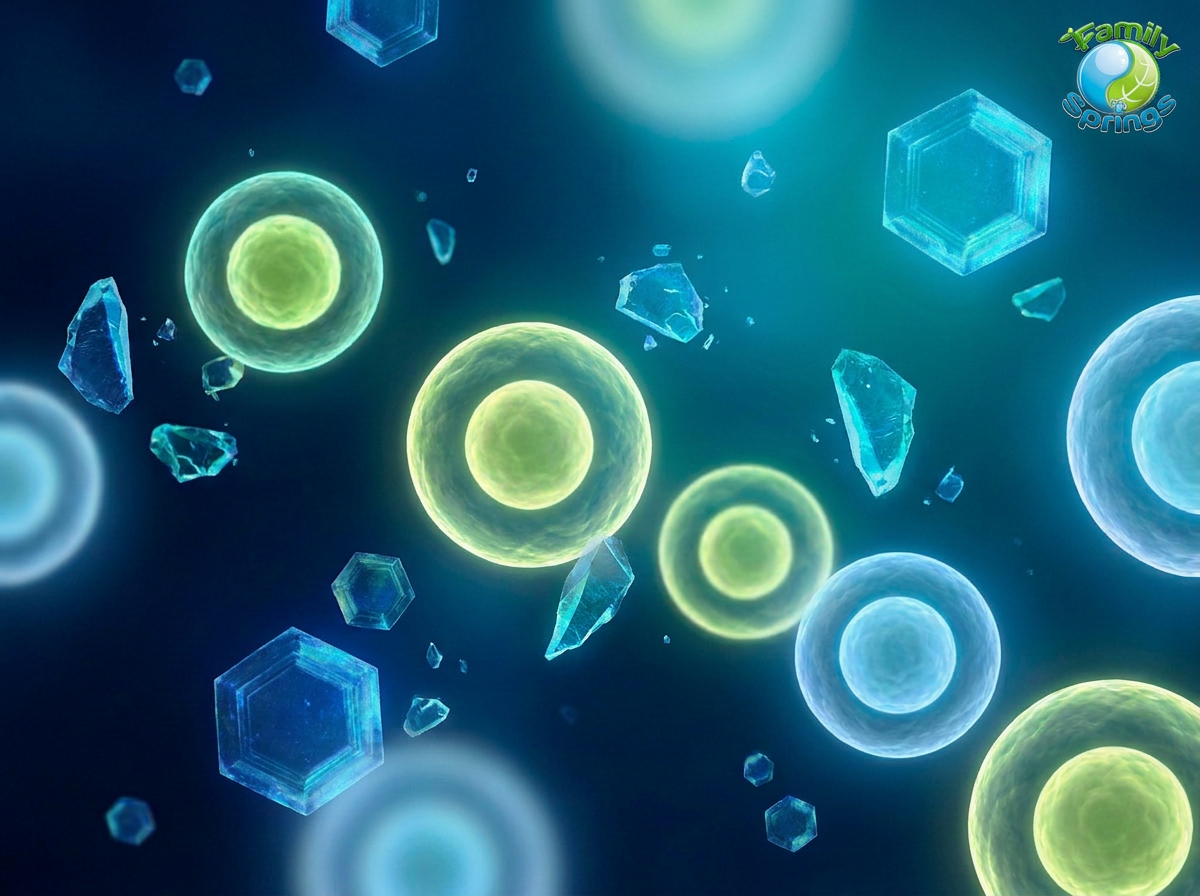
Calcium and magnesium, the same minerals in spring water, act as cellular cofactors for over 300 enzymatic reactions, including every ATP reaction in the human body.
Your Blood Already Knows This
Human blood operates in a pH range of 7.35 to 7.45. That's a window of just 0.10 pH units. Step outside it, even slightly, and the consequences are severe. Below 7.35 is acidosis. Above 7.45 is alkalosis. Both are medical emergencies if sustained.
The body maintains that range continuously, at significant metabolic cost, using what's called the bicarbonate buffer system.
Here's how it works in plain terms: your cells produce carbon dioxide and metabolic acids as byproducts of normal function: breathing, moving, thinking. If those acids weren't neutralized, blood pH would drop and you'd be in trouble within minutes. The bicarbonate in your blood acts as a chemical sponge. It absorbs the excess hydrogen ions, converts them into carbonic acid, which breaks down into water and CO₂, which you then exhale. Your lungs and kidneys work together to keep this balance within that 0.10 unit range, all day, every day.
A 2014 paper published in Frontiers in Physiology shed light on another piece of this: bicarbonate ions don't just buffer; they actively signal inside cells. Specifically, bicarbonate activates an enzyme called soluble adenylyl cyclase, which plays a role in regulating mitochondrial ATP production. This means the same bicarbonate that helps keep your blood pH stable is also involved in how your cells generate energy. The two systems aren't separate. They're part of the same chemistry.
The bicarbonate in spring water (82 mg/L in Family Springs) is the same compound. Structurally identical. Functionally familiar to your body. When you drink it, you're not introducing something foreign. You're delivering a molecule your body already runs on.
The Bohr Effect: When pH Changes How You Breathe
Here's one of the most striking examples of how pH-sensitive the human body actually is at the molecular level.
Hemoglobin, the protein in your red blood cells that carries oxygen, doesn't bind and release oxygen randomly. It does so based on the pH of the surrounding environment. This is called the Bohr effect, and it's one of the most elegant pieces of biochemistry in the body.
When you're working hard, exercising, lifting, running, your muscles produce acid as a byproduct of metabolism. This makes the local pH drop slightly. And in that slightly lower pH environment, hemoglobin releases oxygen more readily. The acid acts as a signal: low pH here means high metabolic demand here, so release the oxygen here.
When you're at rest, the opposite is true. pH rises slightly in less active tissues, and hemoglobin holds onto oxygen more tightly until it's needed.
Your circulatory system is, in part, a pH-sensing oxygen delivery system. The molecule that keeps you alive responds, in real time, to tiny shifts in hydrogen ion concentration.
Research published in PMC has explored how acid-base balance during exercise affects both hydration status and performance markers. When the blood buffer system is working efficiently, which depends in part on having adequate bicarbonate substrate available, the body manages the acid load of exertion more effectively. That's not a marketing claim. It's the mechanism.
"Hemoglobin reads pH like a map, and delivers oxygen exactly where the chemistry says it's needed."
What a 0.1 pH Unit Drop Does to an Ocean
It's worth stepping outside the body for a moment to see just how consequential small pH changes actually are. Because the fish tank is one example. The ocean is another.
Since the Industrial Revolution, the pH of the world's oceans has dropped from approximately 8.2 to 8.1, a shift of 0.1 pH units. That sounds minor. It isn't.
Because of the logarithmic nature of pH, a 0.1 unit drop represents roughly a 26% increase in the concentration of hydrogen ions in the water. NOAA data on ocean acidification documents what followed: coral reefs began losing their ability to build calcium carbonate skeletons. The chemistry of the water shifted just enough to make calcification harder, not because of temperature changes, not because of pollution directly, but because of pH.
The reefs didn't disappear overnight. The animals didn't die immediately. The change was subtle, chemical, invisible. But it was structural. The architecture of the ocean's most biodiverse ecosystems became harder to build and easier to dissolve, because of 0.1 pH units.
The range compatible with human life, pH 6.8 to 7.8, spans exactly one unit. The range the body actually maintains blood within is 0.10 units wide. These aren't abstract numbers. They're the margins within which biology works.

Ocean pH has dropped 0.1 units since industrialization, a 26% increase in hydrogen ion concentration. Coral reefs are restructuring. The fish didn't change. The water chemistry did.
The Same Pattern in Your Garden
The ocean isn't the only place pH shapes what's available. It happens in soil too, and the lesson is the same.
A soil at pH 5 and a soil at pH 7 might have identical mineral content on paper. The same calcium, the same magnesium, the same iron. But at pH 5, most of those minerals are either locked into forms the plant can't absorb, or, in the case of aluminum and manganese, chemically transformed into forms that are actively toxic to root systems.
Plant roots don't lack nutrients because the minerals aren't there. They lack nutrients because pH determines access, not presence.
The parallel to human nutrition is worth sitting with. Bioavailability isn't just about what's in your food or water. It's about the chemical environment in which absorption happens. Mineral water that delivers calcium and magnesium in an already-dissolved, ionic form, as opposed to a solid pill that has to be broken down, meets the body in a form it can work with more directly.
Berkeley Springs: 400 Years of Observation
Before anyone had a pH meter, people gathered at Berkeley Springs in what is now West Virginia.
Indigenous nations traveled there long before European contact, drawn by the free-flowing artesian springs for reasons passed down through generations. George Washington visited at sixteen years old. The town that grew up around the springs became one of the oldest health resorts in North America, drawing visitors for more than two centuries based entirely on what they observed: people who drank from these springs felt better.
They didn't have the language of bicarbonate buffer systems or mineral bioavailability. They didn't know about the Bohr effect. What they had was centuries of accumulated observation, and what they observed has since been documented in biochemistry.
The spring at Berkeley Springs is free-flowing artesian water, naturally pressurized, rising from a limestone aquifer that has been filtering and mineralizing this water over decades. The mineral profile it carries is a direct record of that journey. Bicarbonate. Calcium. Magnesium. pH 7.8.
Family Springs makes the five-to-six hour round trip to collect this water each month. It's not a supply chain. It's a continuation of something people have been doing at this source for longer than the country has existed.

Berkeley Springs, WV: one of North America's oldest documented healing water sources. Indigenous peoples gathered here before European contact. George Washington visited at age 16. The mineral science now explains what generations observed empirically.
What This Water Actually Does and Doesn't Do
Let's be honest about something, because you deserve a straight answer.
Drinking pH 7.8 water does not directly change your blood pH. Your bicarbonate buffer system is far too robust for that. If you drink a glass of alkaline water, your blood doesn't shift alkaline; your body neutralizes it before it gets anywhere near your bloodstream. Anyone telling you otherwise is overstating the science.
What does happen is this:
The bicarbonate you drink is the same chemical your blood already uses to neutralize metabolic acid. When you consume it through water, you're providing substrate to a system that's constantly working. You're not overriding the buffer system; you're supporting it.
You're delivering calcium in a bioavailable, ionic form that research has shown is comparable in absorption to dairy. You're getting magnesium that your mitochondria need to produce ATP. You're consuming water with a mineral architecture that your body already recognizes, because it built its own regulatory chemistry around the same compounds.
That's not a cure. It's not magic. It's not a reversal of any disease.
It's just water that carries the minerals your body runs on, delivered in the form they occur in nature, drawn from one of the oldest documented spring sources in North America.
A Glass of Something That Makes Sense
Every glass of Family Springs water is the same process: water rising from limestone, picking up bicarbonate, calcium, and magnesium along the way, reaching pH 7.8, and then traveling here.
You're not drinking something engineered. You're drinking something that formed, slowly, underground, and emerged with the same mineral chemistry your body already uses to keep itself in balance.
The fish tank keeper adjusts the pH and watches an entire ecosystem respond. The ocean drops 0.1 units and coral reefs begin to dissolve. The hemoglobin in your blood reads local pH like a map and delivers oxygen exactly where it's needed.
pH isn't just a number on a label. It's the water telling you what it's made of.
And what this water is made of is something your body already knows.
Sources and references: This post draws on aquatic biology research on pH and gill function; NOAA ocean acidification data; a 1994 study published in the New England Journal of Medicine on calcium bioavailability from mineral water; research published in Frontiers in Physiology (2014) on bicarbonate and mitochondrial ATP signaling; PMC research on alkaline water, exercise, and acid-base balance; World Health Organization reporting on calcium and magnesium in drinking water; and EPA standards for aquatic life pH tolerance.
Family Springs water is sourced from Berkeley Springs, WV and McRae Springs, NC. Mineral profile: Calcium 32.0 mg/L, Magnesium 3.60 mg/L, Bicarbonate 82 mg/L, pH 7.8.