

Sacred Waters · Series 1, Post 3
Zamzam, the Ganges, and Lourdes: The Springs That Changed the World
Across every continent and every era, humans have found a spring, called it sacred, and built community around it. Here is what those springs have in common, and why Berkeley Springs, West Virginia is part of that story.

Wherever humans have lived for thousands of years, they found a spring. They gave it a name. They said prayers over it. They healed the sick near it. They built cities, temples, and pilgrimage routes around it. This is not a coincidence. It is a pattern so consistent across every culture and every geography that it tells us something fundamental about the relationship between people and water.
This week in the Sacred Waters series, we travel to four of the most significant sacred springs on Earth. Each one carries a different tradition, a different story, and a different community. But all of them point to the same truth: some water is different. Humans have always known it.
Zamzam: The Well That Never Runs Dry
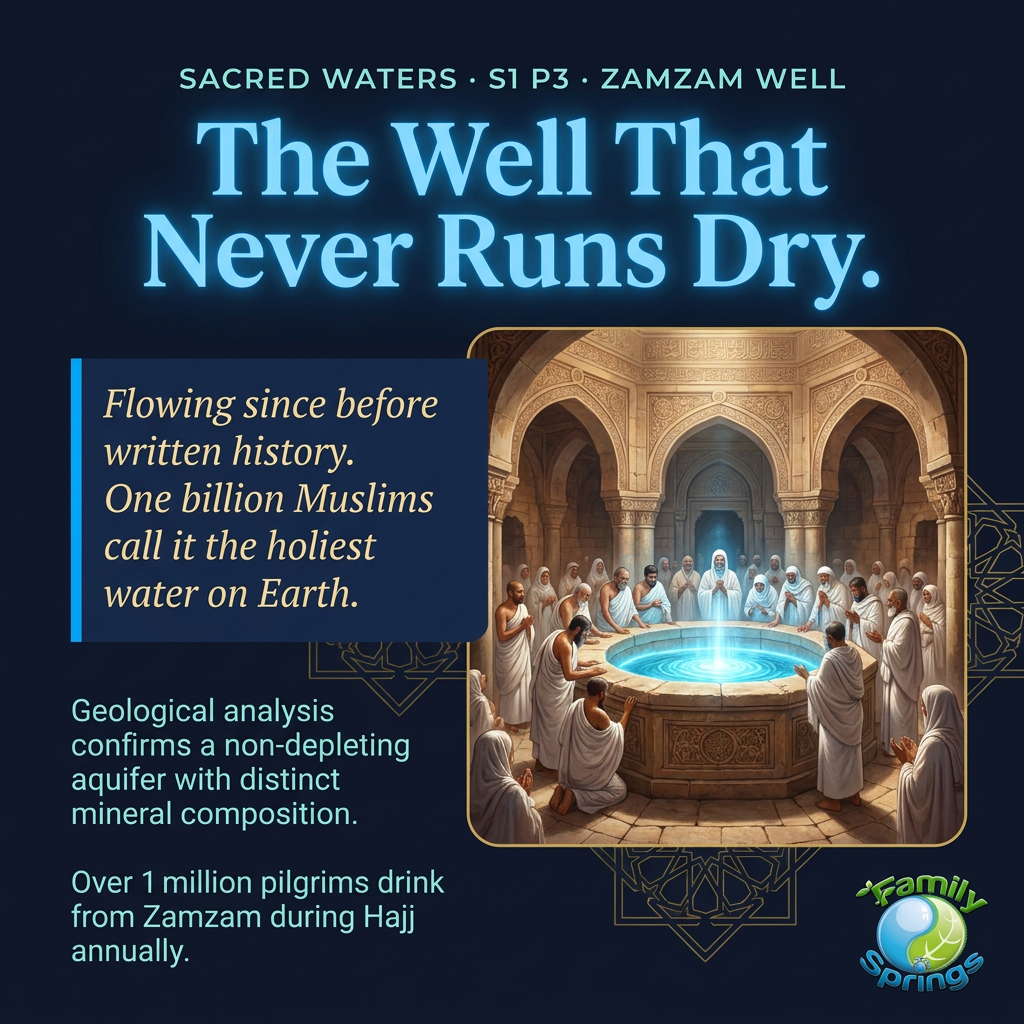
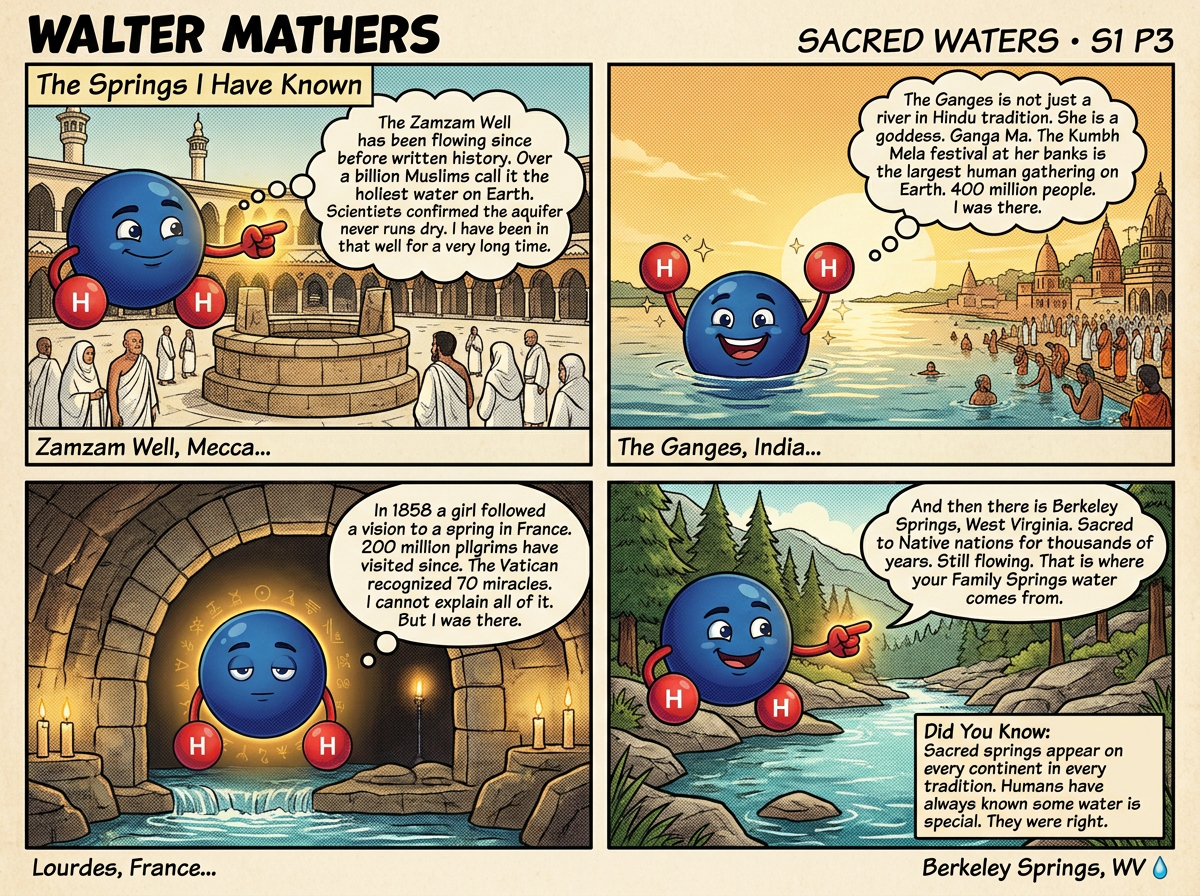
In the center of Mecca, a few meters from the Kaaba, there is a well that has been in continuous use since before written records exist. In Islamic tradition, its origin traces to Hagar, who cried out in desperation in the desert as she searched for water for her infant son Ishmael. The spring appeared. It has never stopped flowing.
"The Zamzam Well is not just a symbol. Geological analysis has confirmed it draws from a non-depleting aquifer with a distinct mineral composition, unlike any surrounding water source."
More than one billion Muslims consider Zamzam the holiest water on Earth. During the annual Hajj pilgrimage, over one million people drink from it directly. Pilgrims carry it home in sealed containers to share with family members who could not make the journey. The water is tested regularly by Saudi authorities and has been studied by scientists who have confirmed its distinct chemical profile. It is not just sacred. It is geologically unusual.[1]
The Ganges: A River That Is a Goddess
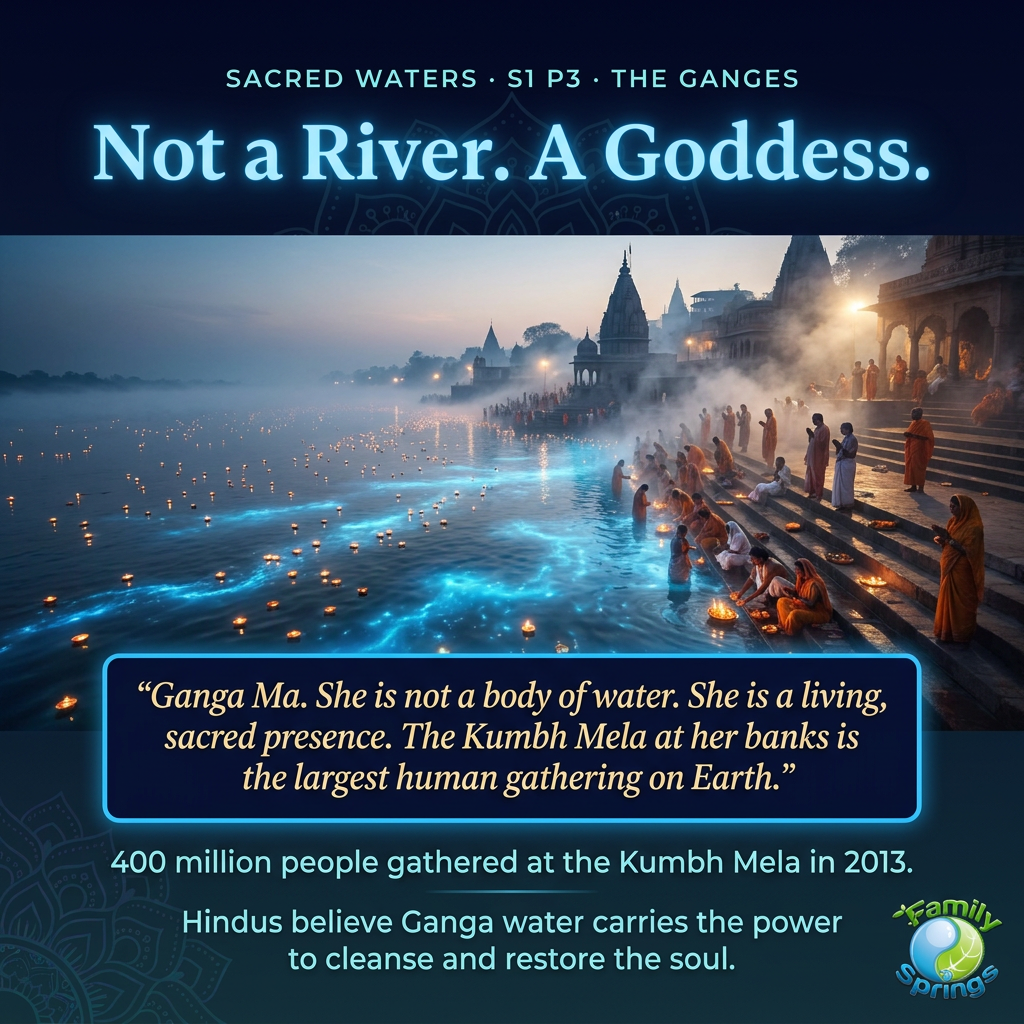
In the Hindu tradition, the Ganges River is not a geographic feature. She is Ganga Ma, the goddess. She descended from the heavens and flows through the earth carrying the power to cleanse sin, free the soul, and grant liberation. This is not metaphor. For hundreds of millions of people, this is lived reality.
The Kumbh Mela, held at the sacred confluence of the Ganges and other rivers, is the largest human gathering on Earth. In 2013, an estimated 400 million people attended. To put that in perspective: that is more than the population of the United States, gathered in one place, around one river, for one spiritual purpose. The Ganges is the most visited sacred water site in the history of human civilization.[2]
Lourdes: 200 Million Pilgrims and 70 Recognized Miracles
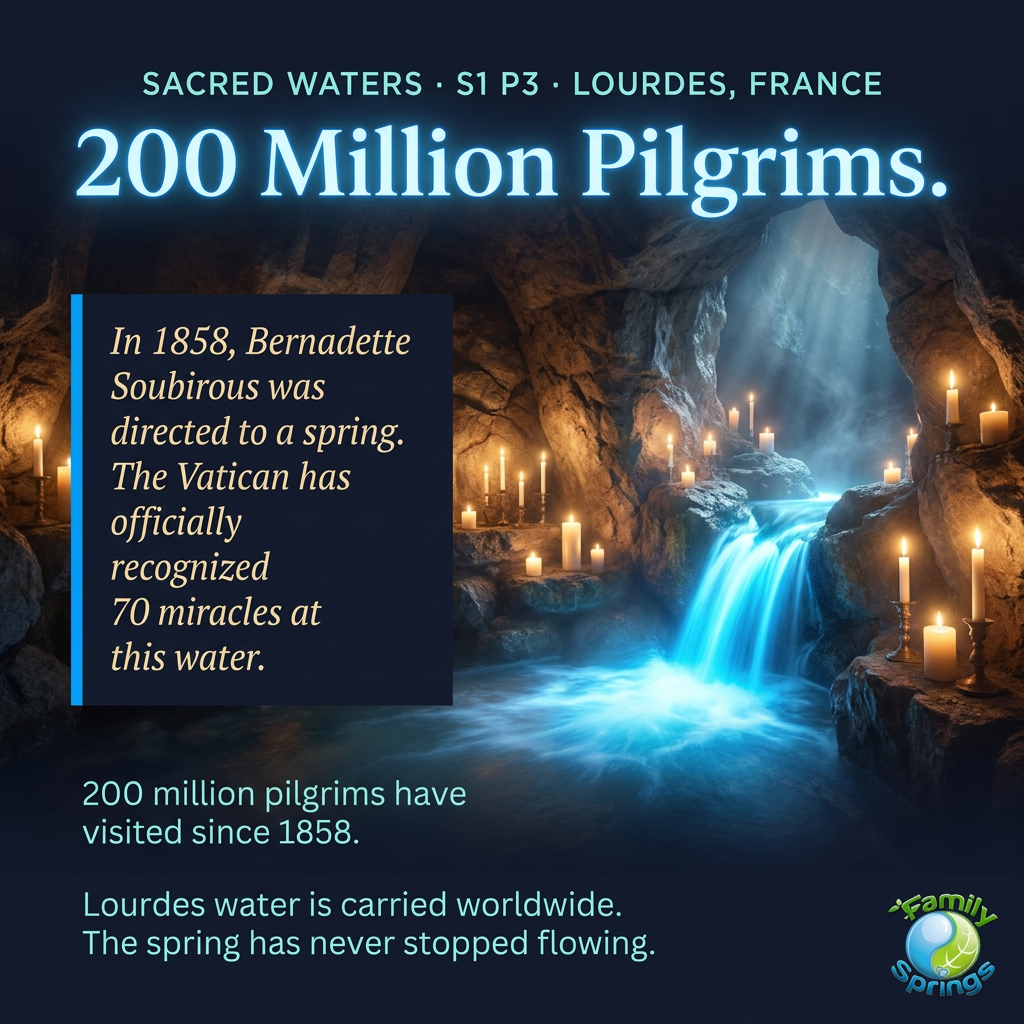
In 1858, a 14-year-old girl named Bernadette Soubirous reported visions of the Virgin Mary near a grotto in southern France. The apparition, she said, directed her to dig in the ground. A spring appeared. Within years, pilgrims were traveling from across Europe. Within decades, the entire world.
More than 200 million pilgrims have visited Lourdes since 1858. The Catholic Church has formally investigated and officially recognized 70 miraculous healings at the site, a process that involves independent medical examination, documentation, and review. The water from the Lourdes grotto is carried worldwide in small blue bottles. For the people who carry it, the water is not a souvenir. It is a living connection to something beyond explanation.[3]
"The pattern repeats across every tradition: a spring appears, a community forms, and the water becomes the center of something larger than the individuals who drink from it."
Sacred Springs Everywhere: From Celtic Holy Wells to Japanese Onsen
Zamzam, the Ganges, and Lourdes are the most visited. But they are not alone. Sacred springs appear on every continent in every major tradition.
In Britain and Ireland, Celtic holy wells number in the thousands. Many predate Christianity and carry the names of local saints who simply absorbed older, pre-Christian water veneration into the new faith. In Japan, onsen, or hot springs, are treated as Shinto sacred sites. In West Africa and across the African diaspora, water spirits and sacred rivers hold central roles in traditional cosmology and healing. Among Native nations across North America, medicine springs and healing waters have served as neutral gathering grounds where even competing nations could come together in peace.[4][5]
The specifics differ. The language differs. But the core understanding is consistent across cultures that developed completely independently of one another: water that comes from the earth, that flows from a source, carries something that standing water or treated water does not.
Berkeley Springs: The Sacred Spring in Our Story
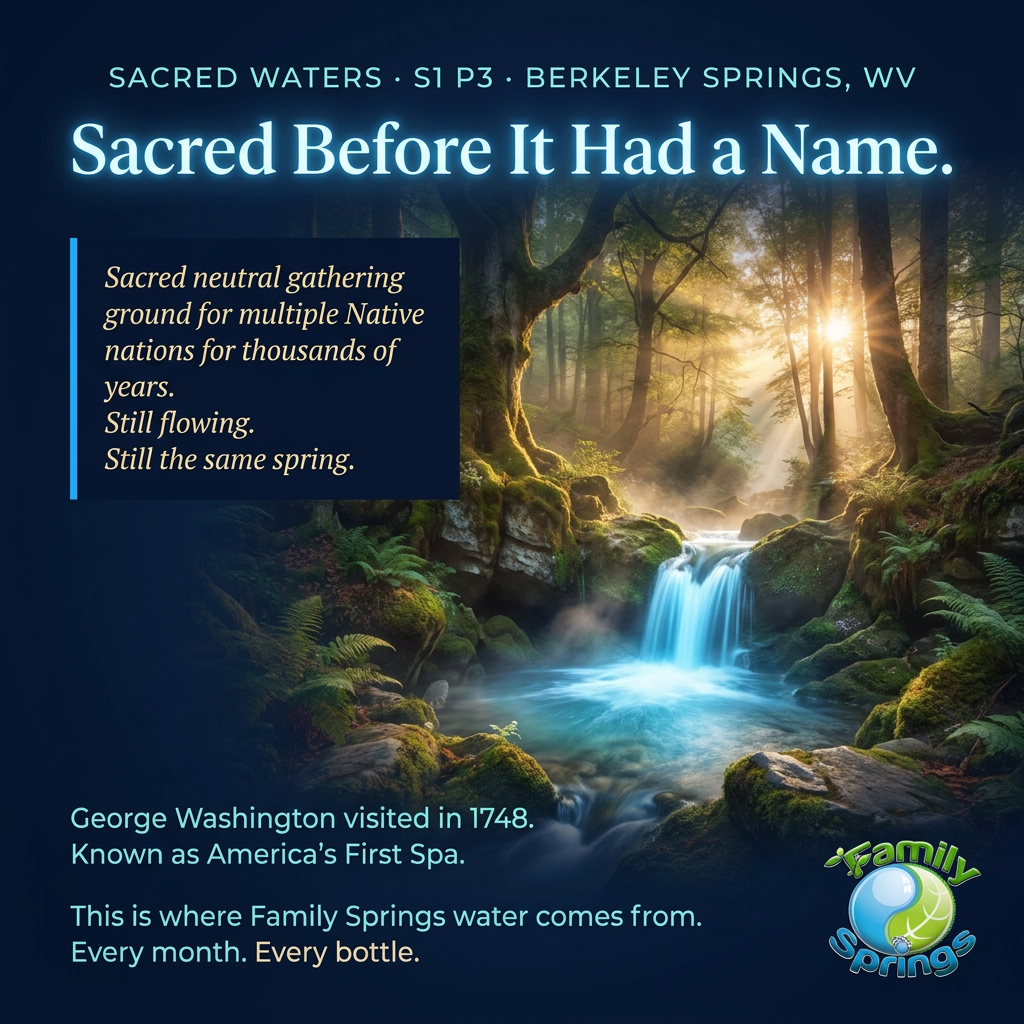
Berkeley Springs, West Virginia has been known as America's First Spa since the 18th century, when George Washington visited in 1748. But that history is a fraction of the full story. For thousands of years before Washington arrived, multiple Native nations used Berkeley Springs as a sacred neutral gathering ground. Groups that might otherwise be in conflict came to Berkeley Springs in peace, to drink from the spring, to heal, to meet. The spring was the reason.
That free-flowing artesian spring is still there. It has never been dammed, rerouted, or industrialized. It flows today exactly as it flowed thousands of years ago. Family Springs sources its water directly from that spring on monthly collection trips made by our own team. The water we bottle comes from the same source that has been considered sacred longer than any written record of the site exists.

The Water in Your Bottle Has a History
None of this is to say that the spring water in your Family Springs bottle is the same as Zamzam or Lourdes. It is not. Each spring is its own place, its own tradition, its own community.
What we are saying is this: the instinct to seek out natural, free-flowing spring water and to treat it with respect is one of the oldest human instincts there is. Berkeley Springs has been doing exactly that for thousands of years. We are one small part of a very long story. Every time you fill a glass from a Family Springs bottle, you are drinking from a spring that has been considered worth protecting across generations, across cultures, and across centuries.
That matters. We think it is worth knowing.
References
- Zamzam Well mineral composition and aquifer geology: https://consensus.app/results/?q=Zamzam+well+mineral+composition+aquifer+geology
- Ganges River sacred Hindu tradition and Kumbh Mela: https://consensus.app/results/?q=Ganges+river+sacred+Hindu+tradition+Kumbh+Mela
- Lourdes water pilgrimage and Vatican recognized miracles: https://consensus.app/results/?q=Lourdes+water+pilgrimage+Vatican+recognized+miracles
- Berkeley Springs, WV Indigenous sacred neutral ground: https://consensus.app/results/?q=Berkeley+Springs+West+Virginia+Indigenous+sacred+neutral+ground
- Sacred springs as universal cultural and religious tradition: https://consensus.app/results/?q=sacred+springs+universal+cultural+religious+tradition+healing