

Sacred Waters · S1 P5
Buddhism and the Way of Water: What Laozi Knew That Neuroscience Just Confirmed
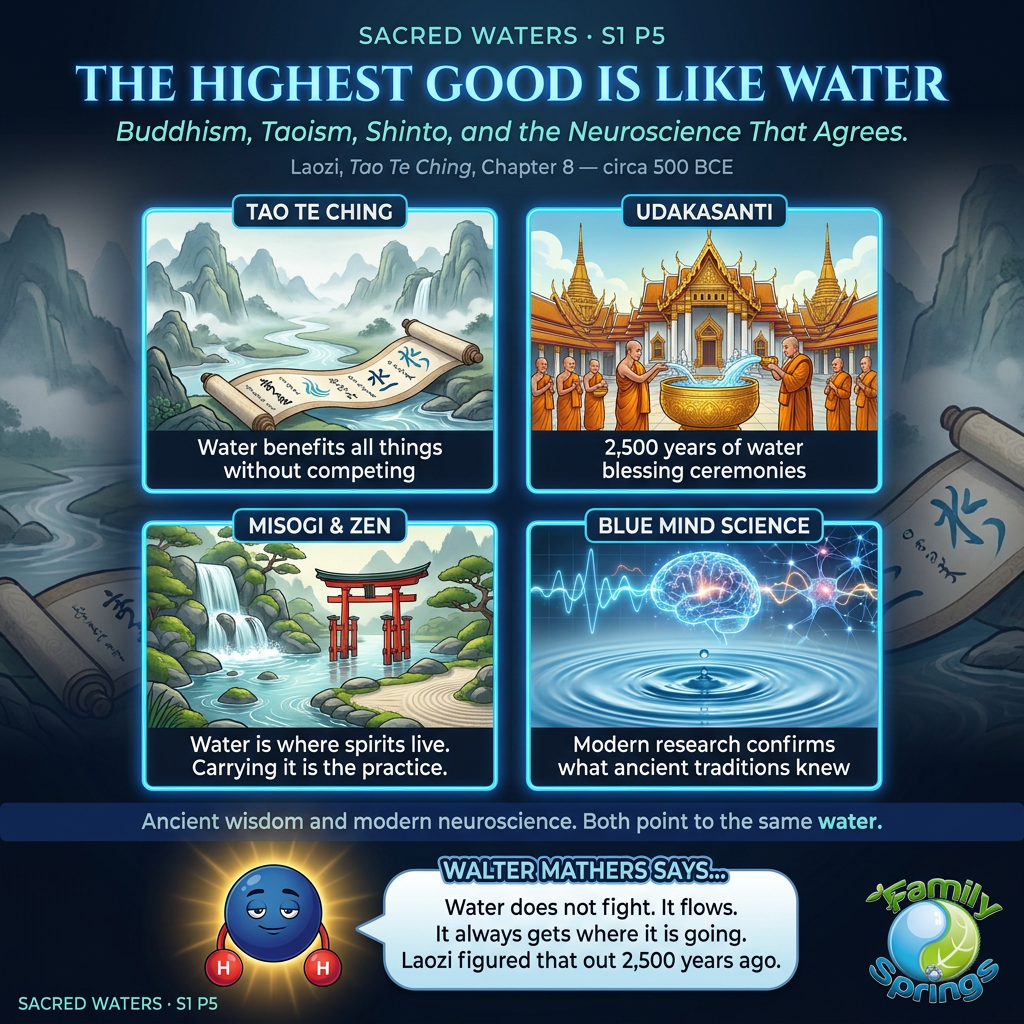
Water is not just a symbol in Asian spiritual traditions. It is the teaching itself. Across more than two thousand years and several distinct traditions, water has been understood as a model for how to live, a vehicle for healing, a dwelling place for the sacred, and a path to presence. What those traditions described long before laboratories existed, researchers are now beginning to measure. This is Week 5 of the Sacred Waters series, and this week we follow water through Taoism, Theravada Buddhism, Zen, Japanese Shinto, and the modern neuroscience lab.
What Laozi observed in the 6th century BCE about water's nature has found unexpected support in 21st-century neuroscience. That is not a coincidence. It is worth paying attention to.
The Tao Te Ching: Water as the Highest Good
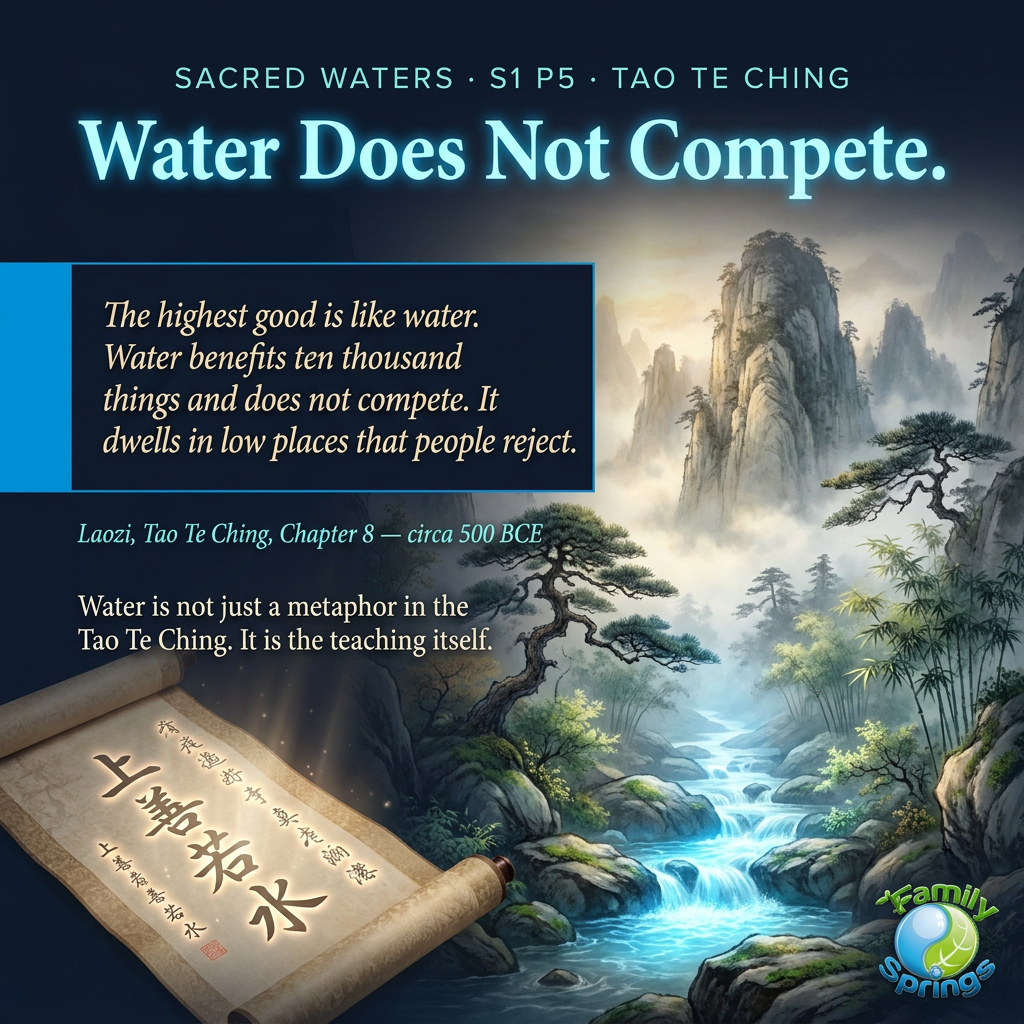
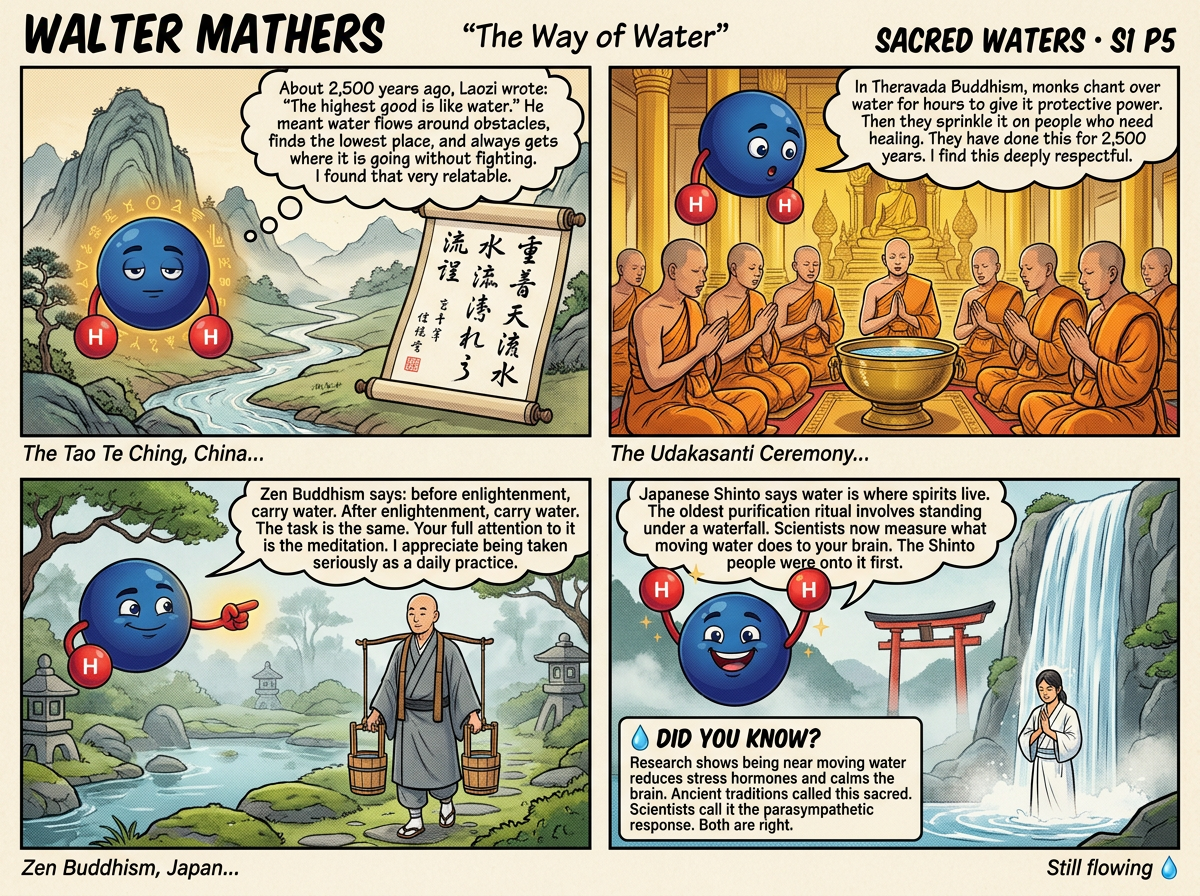
Around the 6th century BCE, a Chinese philosopher named Laozi composed one of the most referenced texts in world history. Chapter 8 of the Tao Te Ching reads: "The highest good is like water. Water benefits ten thousand things and does not compete. It dwells in places that people reject and in this way it is close to the Tao."
This is not a compliment to water. It is a prescription for how to move through the world. Water does not argue with a rock. It goes around it. Water does not climb uphill. It finds the lowest path. It does not insist on arriving. It simply arrives.
The Tao, in Laozi's philosophy, is the underlying order of things: present in everything, nameable by nothing, observable in water more clearly than almost anywhere else. Laozi's point is that the best approach to any situation in life resembles the behavior of water. Yielding without surrendering. Persistent without forcing. Always finding the way through. The Tao Te Ching returns to water again and again across its 81 chapters, because Laozi considered it the most honest mirror of the universe available to the human eye.
The Udakasanti: When Monks Bless Water
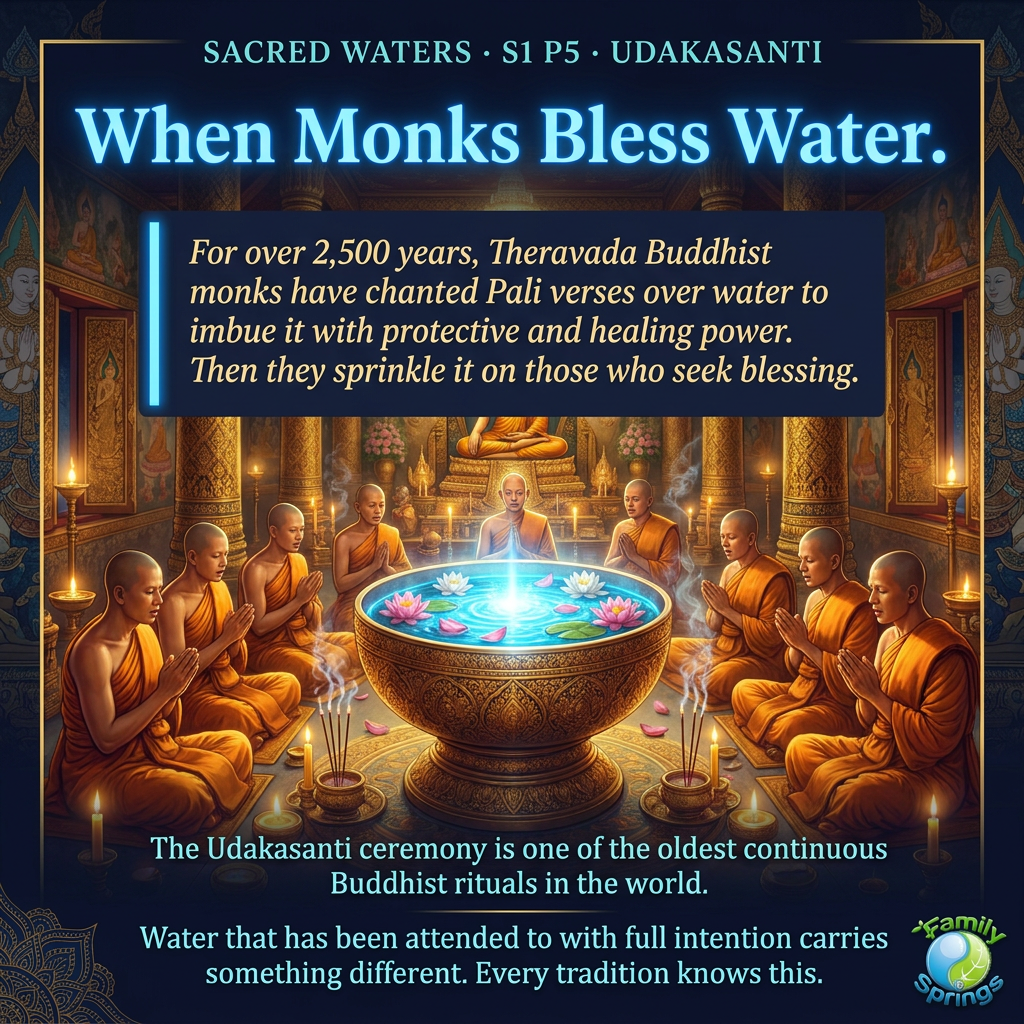
In Theravada Buddhism, practiced across Southeast Asia for more than 2,500 years, there is a ceremony called the Udakasanti. Monks gather and chant Pali verses over a vessel of water for hours. The intention is to imbue that water with protective and healing power. Once the chanting is complete, the blessed water is sprinkled on those who are seeking healing, protection, or good fortune. [2]
This is one of the oldest continuously observed rituals in the Buddhist world. It is still performed today in Myanmar, Thailand, Sri Lanka, and Cambodia. The understanding behind it is not abstract or ceremonial in the surface sense. Water receives intention. Water carries it. And water delivers that care to the people it reaches. The Udakasanti treats water not as a passive substance to be poured over someone but as a living medium for attention and blessing.
Zen: Carrying Water Is the Practice
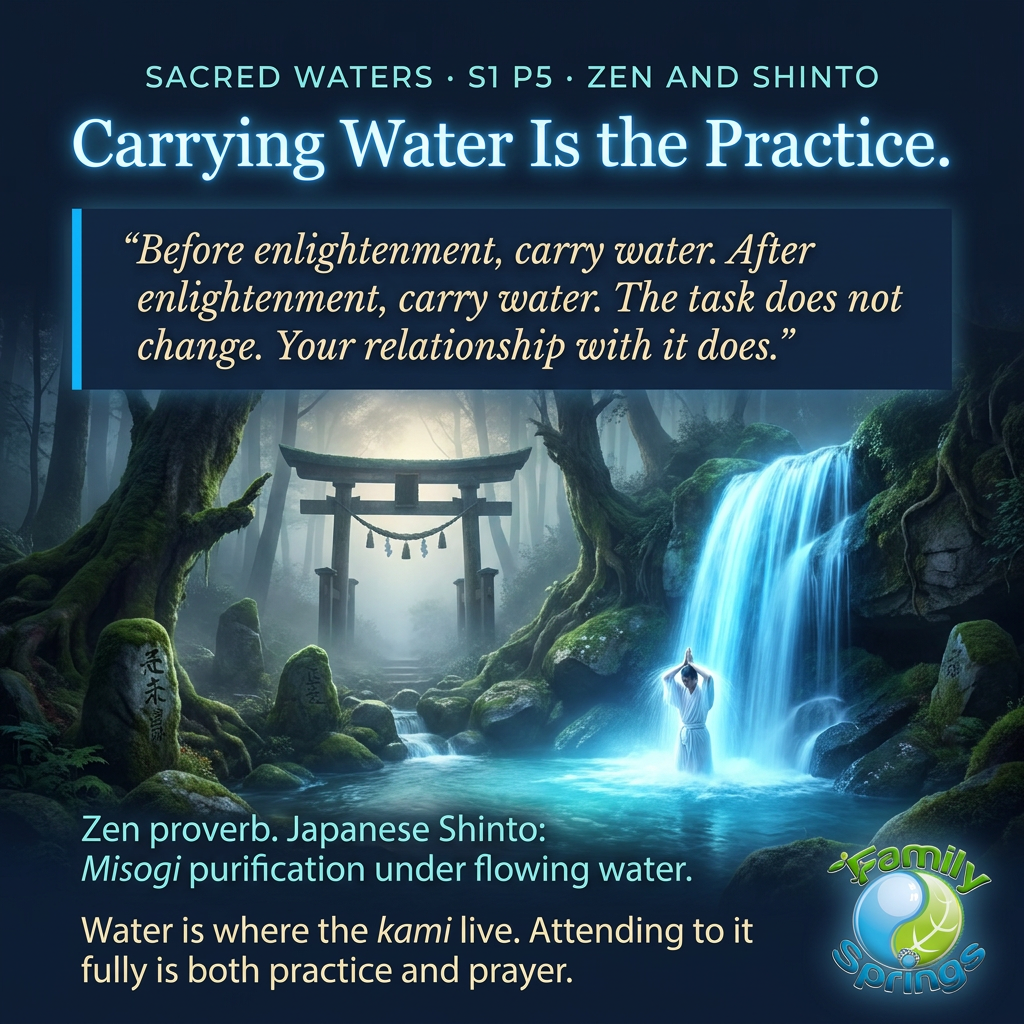
Zen Buddhism offers one of its most powerful teachings about water without any poetry at all: "Before enlightenment, chop wood, carry water. After enlightenment, chop wood, carry water." [3]
The task does not change. What changes is the quality of attention brought to it. In Zen practice, fetching and carrying water is not a chore to be finished before something more important can begin. Attending to water with full presence, without distraction, without any goal beyond the act of carrying water itself, is the practice. In Zen, this is not a metaphor for meditation. It is meditation.
There is something quietly radical in that. The most ordinary task, done with complete attention, becomes a form of awakening. Water, in Zen, is not the subject of the teaching. It is the occasion for it. The teaching only appears when you stop trying to get to the teaching and simply carry the water.
Shinto Misogi: The Kami in the Water
In Japanese Shinto, water is the residence of kami, the spirits that animate and inhabit the living world. Before entering a shrine, worshippers stop at a stone basin near the entrance to purify their hands and mouth with water. Before sacred activities, water removes what should not be carried into the sacred space. [4]
The oldest and most demanding Shinto purification practice is called Misogi. In its fullest form, it involves standing beneath a waterfall, allowing the force of moving water to purify not only the body but the spirit. Misogi is still practiced today by people across Japan who take their Shinto practice seriously. The relationship between flowing water and spiritual clarity is, in Shinto, not symbolic. The waterfall is not a representation of purification. It is the purification itself. Moving water carries away what does not belong and returns the person to a state of clarity. This is as literal as it sounds.
Blue Mind: Ancient Wisdom, Modern Measurement
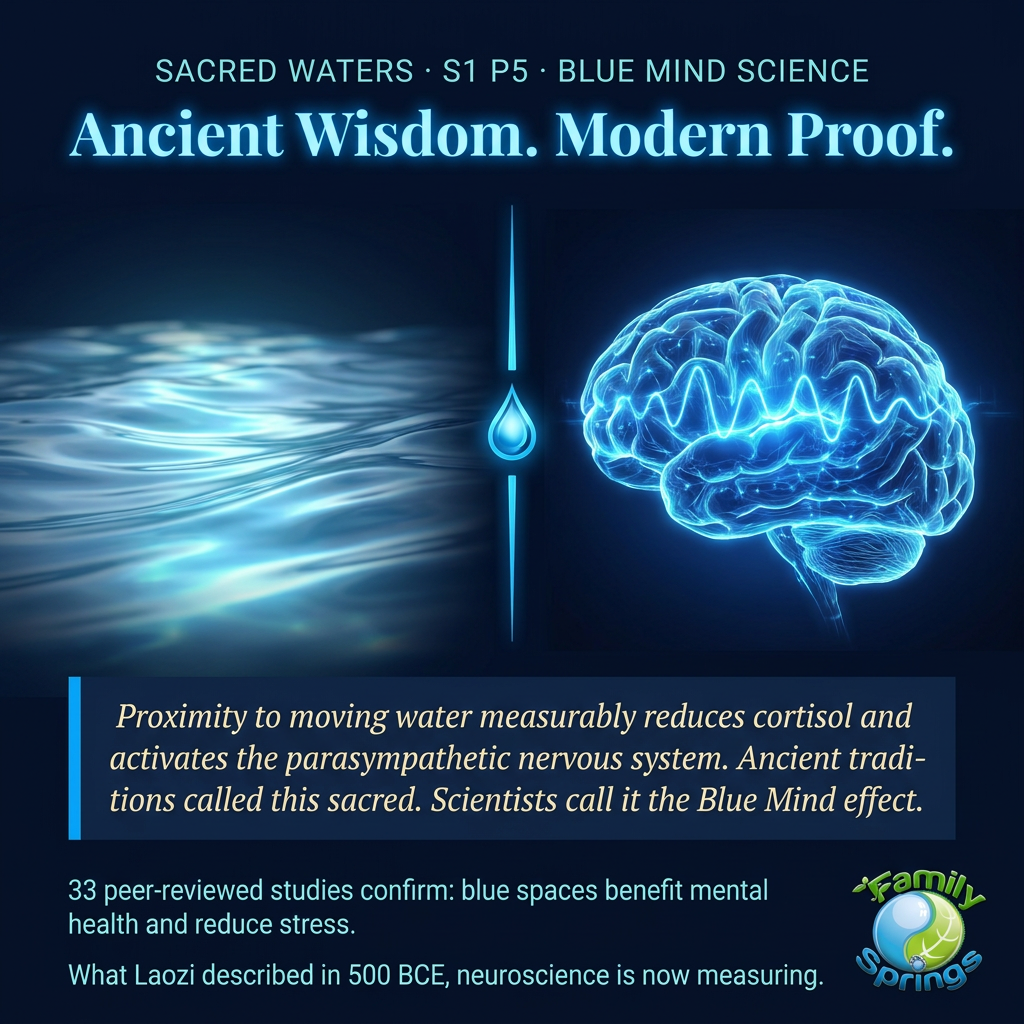
In the early 2010s, marine biologist Wallace Nichols began publishing research on what he called "blue mind": the measurable cognitive and emotional state that proximity to water produces. The peer-reviewed research that followed confirmed what Nichols described. The sight, sound, and presence of moving water reduces cortisol levels, activates the parasympathetic nervous system, and induces a calm, meditative state associated with clarity and reduced anxiety. [5]
The parasympathetic nervous system is the body's rest-and-restore mode. It is the counterweight to the fight-or-flight stress response most of us spend too much of our time running on. Water activates it. This is now measurable in controlled laboratory conditions.
What Laozi described as alignment with the Tao, what Zen monks experienced while carrying water with full attention, what Shinto practitioners felt standing under the falls during Misogi: these are, in part, descriptions of the same neurological shift. Ancient traditions called it sacred. Scientists call it a parasympathetic response. Both are right. Both are describing the same thing. The traditions arrived there through observation and practice. The laboratory arrived there through measurement. The destination is the same.
Flowing Without Effort
The water at Berkeley Springs, West Virginia has been moving through limestone and sandstone for thousands of years. It does not compete. It does not force. It finds its path, surfaces into the light, and arrives carrying minerals from the mountain with it. That is not just geology. In the language of Laozi, it is close to the Tao.
Each month, we drive to Berkeley Springs to collect it fresh. We filter it twice, treat it with UV light, and deliver it to your door in Hampton Roads within days of collection. We try not to get in its way. The water has been finding where it needs to go for a very long time. We are just the ones who carry it.

Meet Walter Mathers
Walter is Family Springs' official H2O guide, a water molecule with a lot to say. Every week, Walter breaks down the science, history, and wonder of water in plain language for all ages. Find the full Walter Mathers archive at familyspringswater.com.
This is Week 5 of the Sacred Waters series. Every tradition, every ceremony, every spring tells the same story. Find all six installments at the Family Springs Gazette.
Read the SeriesSources
- Tao Te Ching water philosophy, Laozi: consensus.app/results/?q=Tao+Te+Ching+water+philosophy+Laozi+highest+good
- Udakasanti Buddhist water blessing ceremony: consensus.app/results/?q=Udakasanti+Buddhist+water+blessing+ceremony+Theravada
- Zen Buddhism water mindfulness practice: consensus.app/results/?q=Zen+Buddhism+water+mindfulness+chop+wood+carry+water
- Shinto Misogi water purification ritual, kami, Japan: consensus.app/results/?q=Shinto+Misogi+water+purification+ritual+kami+Japan
- Blue Mind neuroscience, water, cortisol, parasympathetic: consensus.app/results/?q=blue+mind+water+proximity+cortisol+reduction+neuroscience
Scheduled: Morning Water Industry News Digest