

Sacred Waters · Series 1 · Part 2
The Mikveh, the Jordan, and the Font: Three Faiths, One Truth About Water
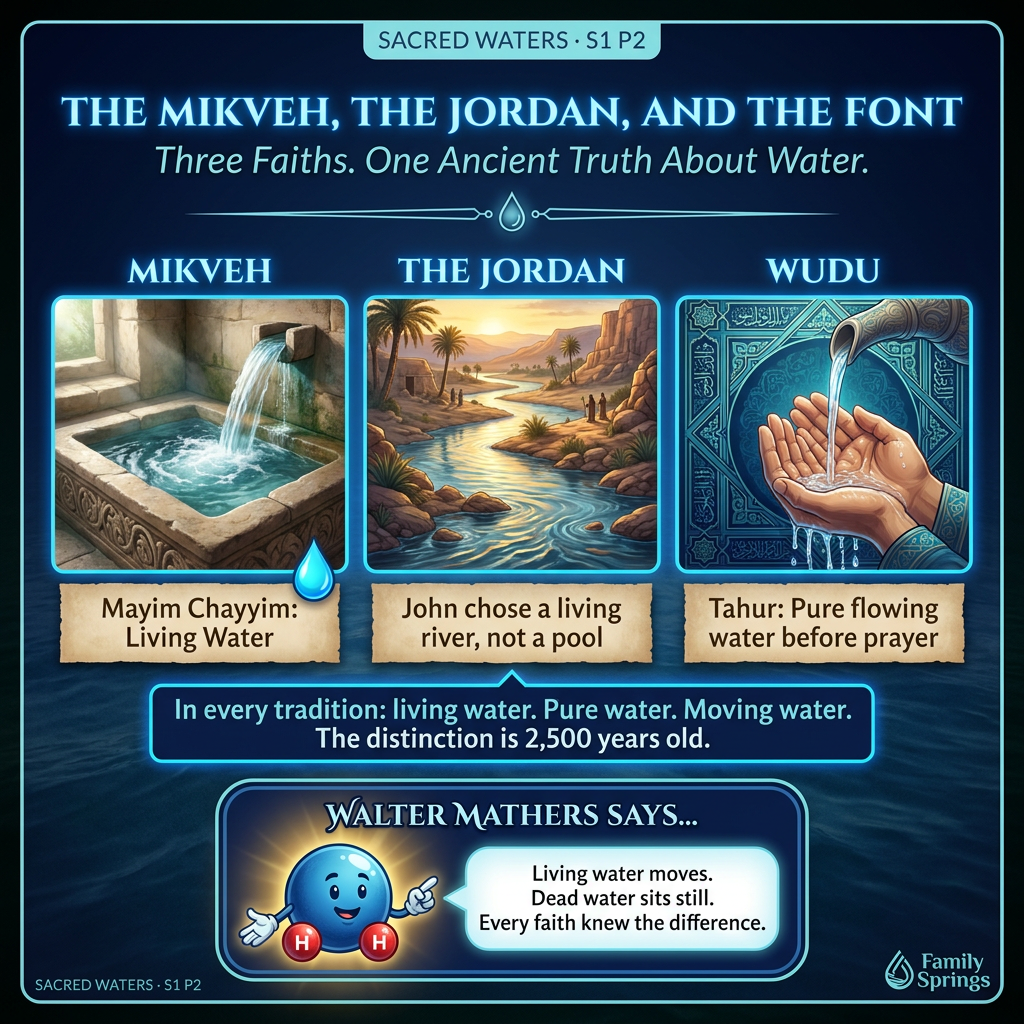
Infographic: Three faiths, one ancient agreement about water. [Image will be swapped before publish.]
The concept of "living water" predates modern water science by thousands of years. Long before chemists could measure mineral profiles, or microbiologists could trace the difference between a natural spring and a municipal treatment plant, religious traditions around the world were drawing a hard line between two kinds of water. One was alive. One was not. What strikes researchers today is how consistent that distinction became across cultures and centuries that had no contact with each other.
This is the second article in Family Springs' Sacred Waters series, which traces the role of water in human culture, faith, and science. Last week we examined the creation waters across world mythology. This week, we go inside three living traditions that have never stopped practicing what they preach about water.
"The oldest religious disagreements about water purity encode a distinction modern water science has now confirmed: water from natural, flowing sources carries a fundamentally different mineral and biological profile than treated or held water."
The Jewish Mikveh: Only Living Water Will Do
The mikveh is one of the oldest continuously practiced rituals in Judaism, with documentation stretching back more than 2,500 years. It is a ritual immersion bath used for spiritual purification. But not just any water qualifies. Jewish law requires mayim chayyim, literally "living water": water from a natural spring, rainwater, or a free-flowing river. Tap water, treated water, or water that has been held in a vessel does not meet the standard.
The reasoning encoded in Jewish legal tradition is precise. The water must retain its natural character. It must come from the earth, move of its own accord, and carry no human alteration. This is not metaphor. It is a specification with practical teeth, maintained in continuous practice for millennia across Jewish communities on every continent.[1]
The Jordan River: Why John Chose a River, Not a Pool
Christian baptism drew directly from Jewish immersion practice. When John the Baptist chose his location, he chose the Jordan River. This was deliberate. The Jordan is a living river, fed by springs and snowmelt, flowing and moving continuously. John could have used a cistern or a stone pool. He did not.
The word "baptism" itself comes from the Greek baptizo, meaning to immerse fully in water. The earliest Christian baptismal practice, before stone fonts became standard in churches, was performed in flowing rivers and streams wherever possible. The choice of living, moving water was not a logistical convenience. It was the point.[2]
Islamic Tahur: Purity Before Prayer
Islam is equally explicit. The Quran, in Surah Al-Maida (5:6), commands believers to purify themselves with water before prayer. The water required for both wudu (partial ablution) and ghusl (full immersion) must be tahur: pure and purifying.
Islamic legal scholars have clarified over centuries what makes water tahur and what disqualifies it. Water that has been held too long, water altered in taste, smell, or color, water contaminated by external material: all of these fall short. Natural, flowing, unaltered water holds the highest status in Islamic purification law. Three distinct legal traditions. Three separate scholarly lineages. The same core distinction about water.[3]
The Blessing of Waters: Orthodox Epiphany and Hagiasmos
In Orthodox Christianity, the Feast of Epiphany brings the Great Blessing of Waters, known in Greek as hagiasmos. The ceremony blesses rivers, lakes, and seas. The water blessed at Epiphany is held to carry healing and purifying properties for the year ahead, and families collect it to keep in their homes.[4]
The theology here draws specifically on Christ's baptism in the Jordan. The moment of the original immersion in living, flowing water is understood to have blessed all water of its kind. The water honored at Epiphany is natural water, water from the created world, not a laboratory formulation.
The Distinction That Keeps Appearing
What is striking about all four of these traditions is the consistency of the underlying distinction. Living water moves. It comes from a source in the earth. It carries minerals from the rock and soil through which it has traveled. Dead water, in the language of these traditions, sits still. It has been held, altered, or separated from its source.
Modern water chemistry did not exist when these laws were written. But the distinction they encode maps onto something real. Natural spring water carries a mineral profile shaped by its passage through rock: the calcium, magnesium, and bicarbonate content of a spring reflects the geology of the aquifer it travels through. Treated water, by contrast, has had its mineral content adjusted, chlorinated, and filtered to meet safety standards. The character is different. These traditions understood that before anyone had words for it.[5]
"Living water moves. It comes from a source in the earth. It carries minerals from the rock through which it has traveled. Every tradition drew this line. Now science can measure why."
Berkeley Springs Is a Living Spring. That Is Not Incidental.
Berkeley Springs, West Virginia, is where Family Springs sources its water. It is a free-flowing artesian spring. The water moves continuously upward through the rock, carrying what the earth has added to it over centuries: calcium at 32.0 mg/L, magnesium at 3.60 mg/L, bicarbonate at 82 mg/L. It is double-filtered and UV-treated after collection, but it is never held in a way that alters its fundamental mineral character.
In the oldest sense of the phrase used by Jewish, Christian, and Islamic traditions alike, this is living water. That is not a marketing claim. It is a description of what the water is and where it comes from. We chose Berkeley Springs because of that character. Every tradition in this series, including those we will cover in the weeks ahead, would recognize it.

Walter Mathers Explains
"Living water moves. Dead water sits still. Jewish law figured that out 2,500 years ago. Christianity and Islam said the same thing. Now scientists can actually measure the difference in mineral content. Every tradition was describing something real." Read this week's Walter Mathers comic strip for the full story, at a 5th grade reading level.
Sources & Further Reading
- Mikveh and the living water requirement in Jewish law (mayim chayyim): consensus.app/results/?q=mikveh+living+water+mayim+chayyim+Jewish+ritual+purity
- Christian baptism, John the Baptist, and the Jordan River: consensus.app/results/?q=Christian+baptism+Jordan+River+living+water+history
- Islamic wudu, ghusl, and tahur water requirements in the Quran: consensus.app/results/?q=Islamic+wudu+ghusl+tahur+water+purification+Quran
- Orthodox Christianity, hagiasmos, and the Epiphany blessing of waters: consensus.app/results/?q=Orthodox+Christianity+holy+water+hagiasmos+Epiphany+healing
- The living water vs. dead water distinction across spiritual traditions: consensus.app/results/?q=living+water+dead+water+spiritual+distinction+natural+spring