

Sacred Waters · Season 1, Part 4
Ubuntu, Oya, and the Waters of Africa: The Water Spirituality That Crossed the Atlantic
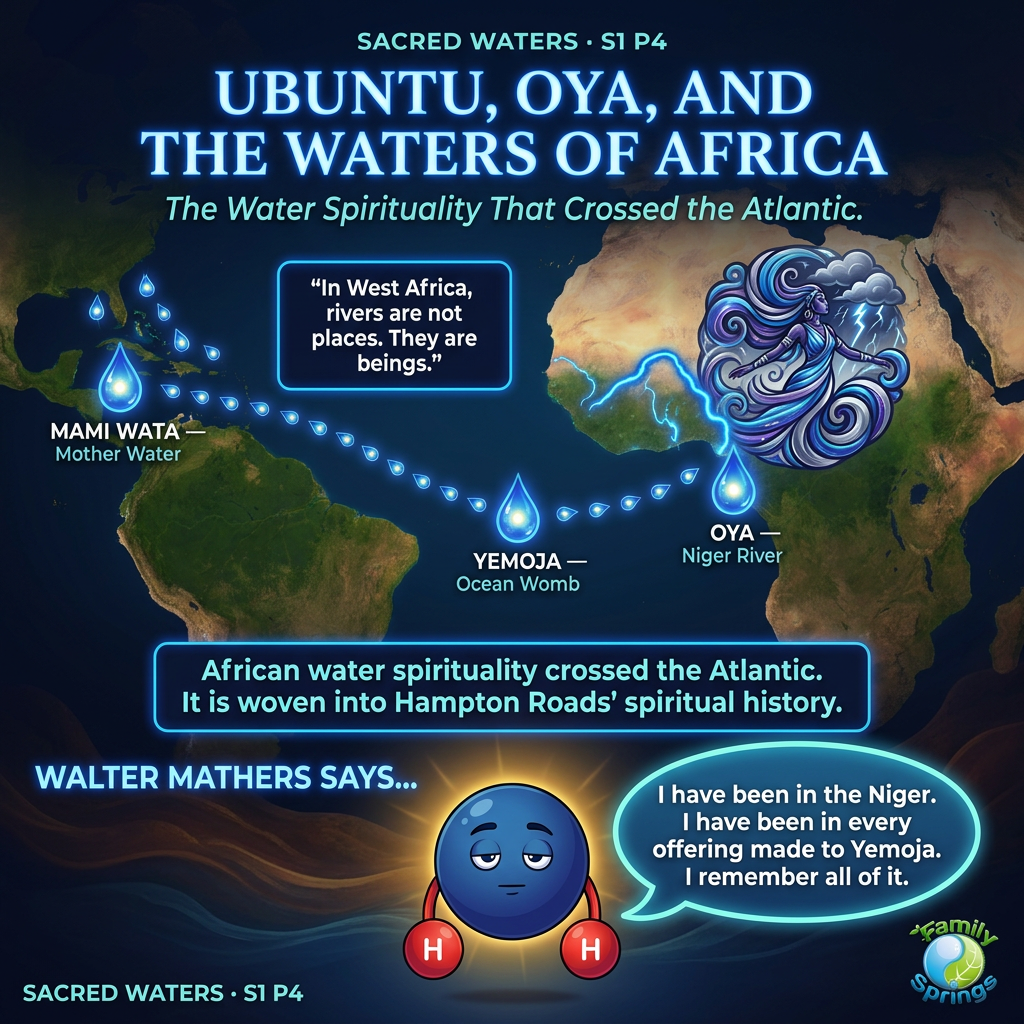
In West African cosmology, water is not a resource. It is a being. It has names. It has power. It carries the memory of the living and the dead. Long before the bottled water industry, long before municipal water systems, long before anyone thought to put a pH number on a label, West African peoples understood water as something that deserved relationship, not just use. That understanding did not stay in Africa. It crossed the Atlantic, carried by millions of people who were forced to make that crossing in chains. And it is still alive today, including here in Hampton Roads, Virginia.
Oya: The Orisha of the Niger River
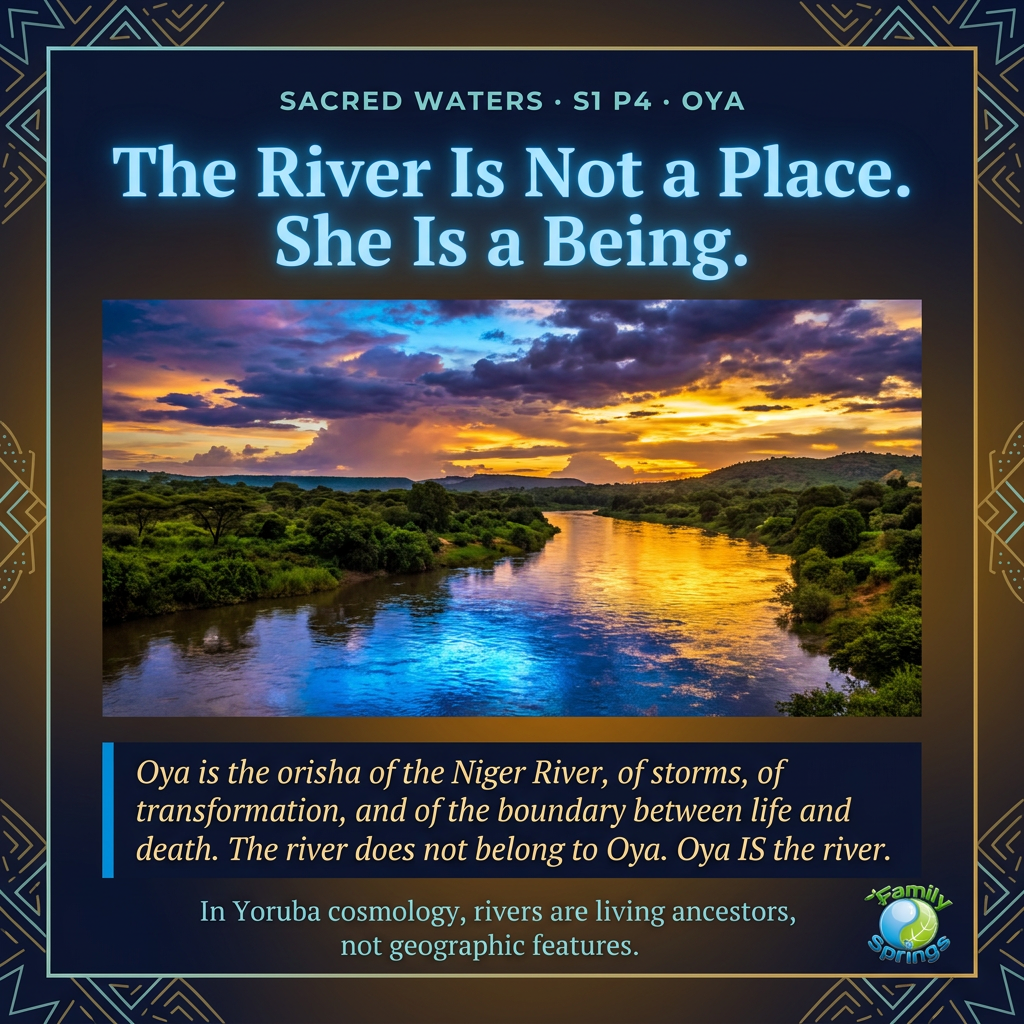
In Yoruba tradition, one of the most ancient and complex spiritual systems in human history, rivers are not places you visit. They are beings you enter into relationship with. The Niger River, one of West Africa's great waterways, is understood not merely as a body of water but as Oya herself, one of the most powerful orishas in the Yoruba pantheon. [1]
Oya governs transformation. She rules over the boundary between life and death. She commands storms, winds, and the force of moving water. She is associated with change in its most elemental form, the kind of change that sweeps everything away and makes room for what comes next. When the Niger River rises or shifts course, that is not an impersonal geological event. That is Oya, moving.
"In Yoruba cosmology, a river is not a place. It is a being."
Sacred WatersThis is a fundamentally different way of relating to water than most of us were raised with. Oya does not ask for your engineering plans. She does not wait for your assessment of her mineral content. She asks for reverence, for attention, for the acknowledgment that she was here before you and will remain after you. The Yoruba relationship with the Niger is not passive admiration. It is a living conversation, one that has continued for centuries.
Mami Wata: Mother Water Across Two Continents
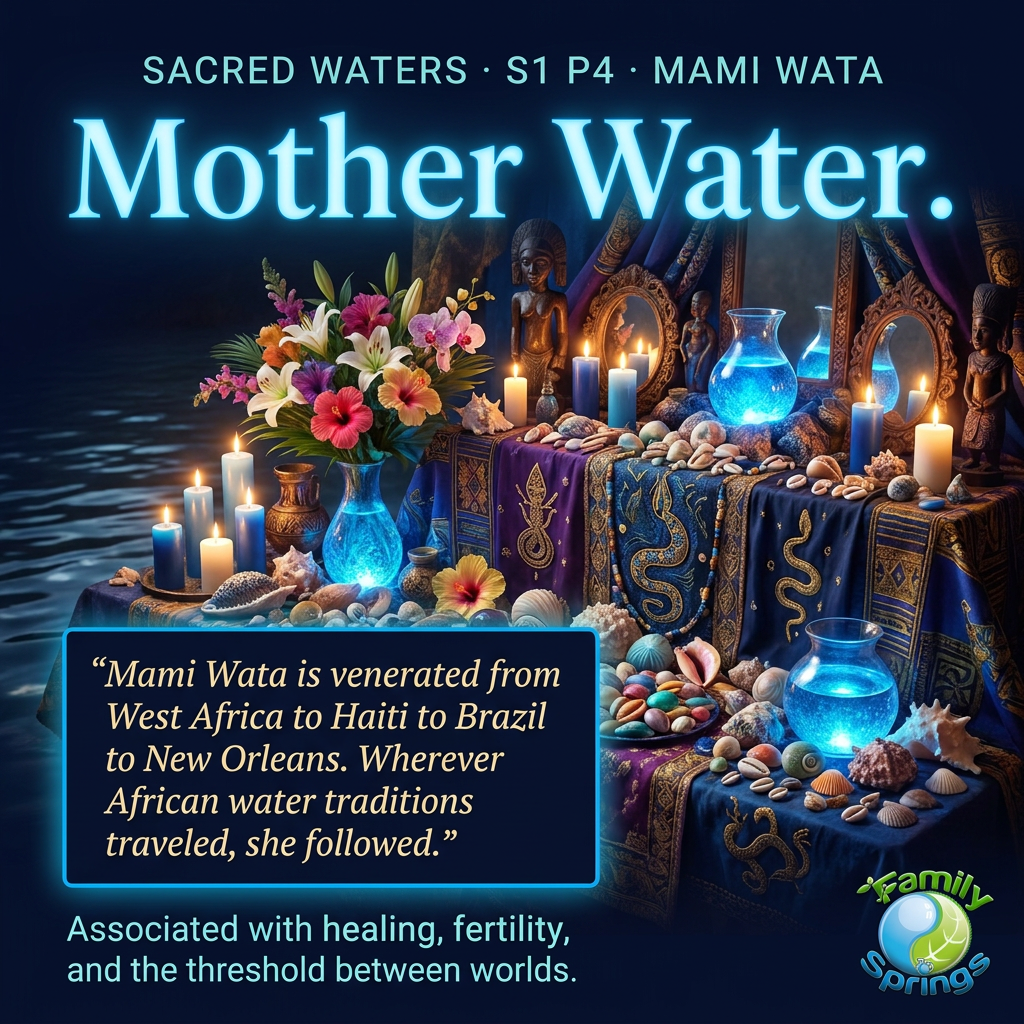
If you have ever been in a city with a significant West African diaspora population, from Lagos to New Orleans to Brooklyn, you may have encountered the name Mami Wata. Translated as Mother Water, she is venerated across sub-Saharan Africa and throughout the African diaspora in Haiti, Brazil, and the United States. [2]
Mami Wata is associated with healing, fertility, beauty, and the meeting of worlds. Her shrines, found from coastal West Africa to New Orleans, are adorned with mirrors, combs, and serpents, symbols of wisdom, reflection, and the fluid boundary between the world of the living and the world of the spirits. She is understood as a keeper of waters and a healer of those who come to her with reverence and need.
What is remarkable about Mami Wata is how far she traveled and how she changed along the way. In different communities across two continents, she adapted to local contexts while keeping her essential nature intact. She is water's capacity to move, to shift form, and to carry life across great distances. She is also the story of what African spiritual traditions did in the face of displacement: they did not disappear. They traveled.
Yemoja: The Ocean as the Womb of All Life
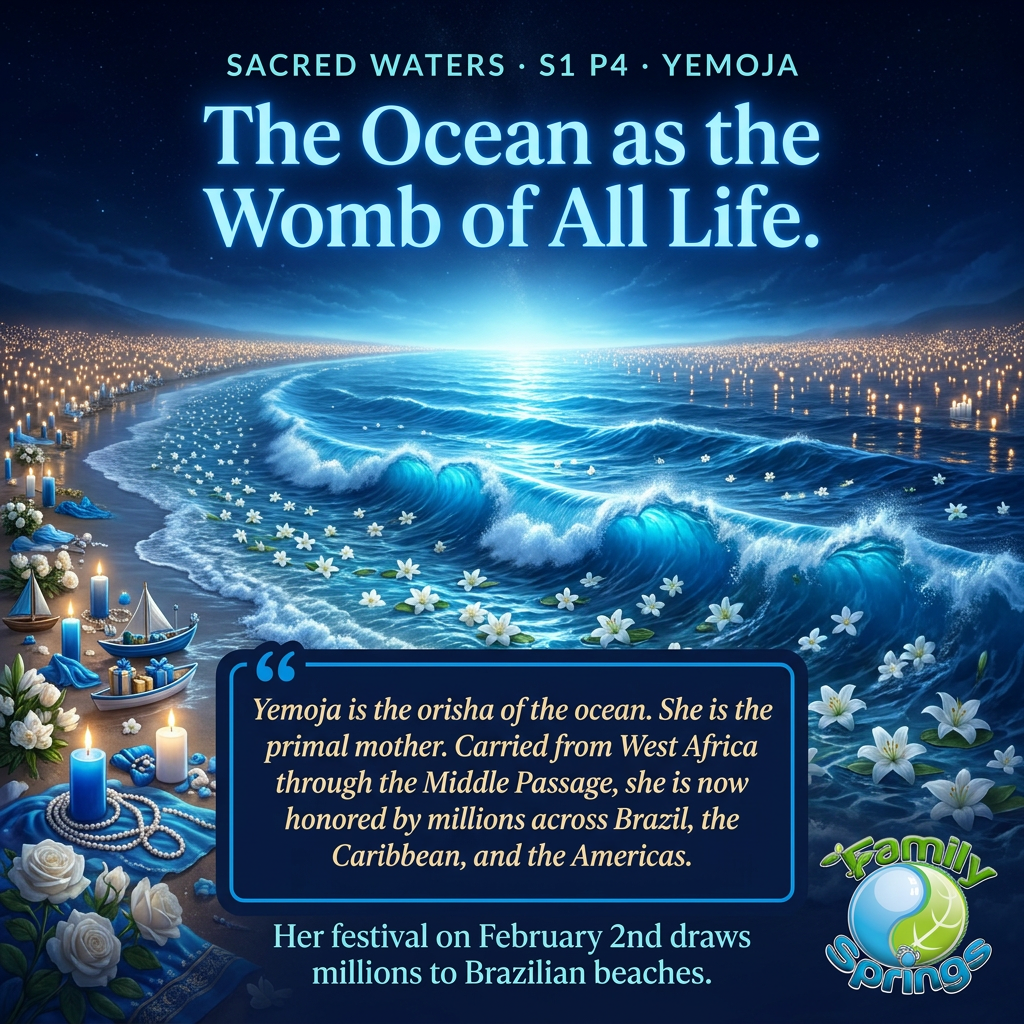
Among the most widely venerated figures in the African diaspora is Yemoja, known in Brazil as Yemanja and in Cuba and other parts of the Caribbean as Yemaya. She is the orisha of the ocean, understood as the primal womb from which all life emerged. Her name in Yoruba translates roughly to "Mother whose children are like fish," an acknowledgment that she is the source of uncountable life. [3]
Yemoja crossed the Atlantic through one of history's greatest acts of violence: the transatlantic slave trade. Enslaved Africans, separated from their land, their communities, and their languages, held on to their spiritual relationships with water. And Yemoja, the mother of the ocean, traveled with them across the very waters that were being used as a weapon against them. That is a kind of defiance that is almost impossible to put into words.
"Yemoja traveled across the very ocean that was being used as a weapon. She did not abandon her children. She became the crossing itself."
Sacred WatersToday, on February 2nd each year, millions of people in Brazil walk to the shore to honor Yemanja. They bring flowers, candles, and small boats as offerings, setting them on the water to be carried out to sea. It is one of the largest religious gatherings in the Americas. The woman who began as an orisha of the Yoruba people of West Africa now draws millions of people to the Brazilian coast. That is what happens when a tradition is carried by people who refuse to let it die.
Yemoja is also venerated in Candomble, Umbanda, Santeria, and Vodou, four distinct traditions that developed in different parts of the Americas as African spiritual practices merged with Indigenous and Catholic elements. She is present in all of them. The ocean is her body. The ocean is everywhere.
The Nile and Isis: Water, Grief, and Renewal
Farther north, in the Nile Valley, another civilization built its spiritual and agricultural life around a river. In ancient Egyptian tradition, the annual flooding of the Nile was the event that made life possible. Without it, the fields stayed dry. Without it, the harvest failed. Without it, Egypt did not exist as a civilization. [4]
But the Egyptians did not understand this flood as a mechanical weather event. They understood it as grief. Each year, the goddess Isis wept for her murdered husband Osiris, and her tears caused the Nile to rise. The water that gave life arrived through loss. The flood that fed every family in the kingdom was an act of mourning.
This is one of the most profound ideas in the history of water and spirituality: that renewal comes through grief, that the thing that sustains life is not always joyful, that water carries both. Every river that floods a field was, in some sense, a tear. Every crop that grows from that flooding is born from something that hurt. Ancient Egypt understood this. They built a civilization on it.
The River Baptism: Africa in Hampton Roads
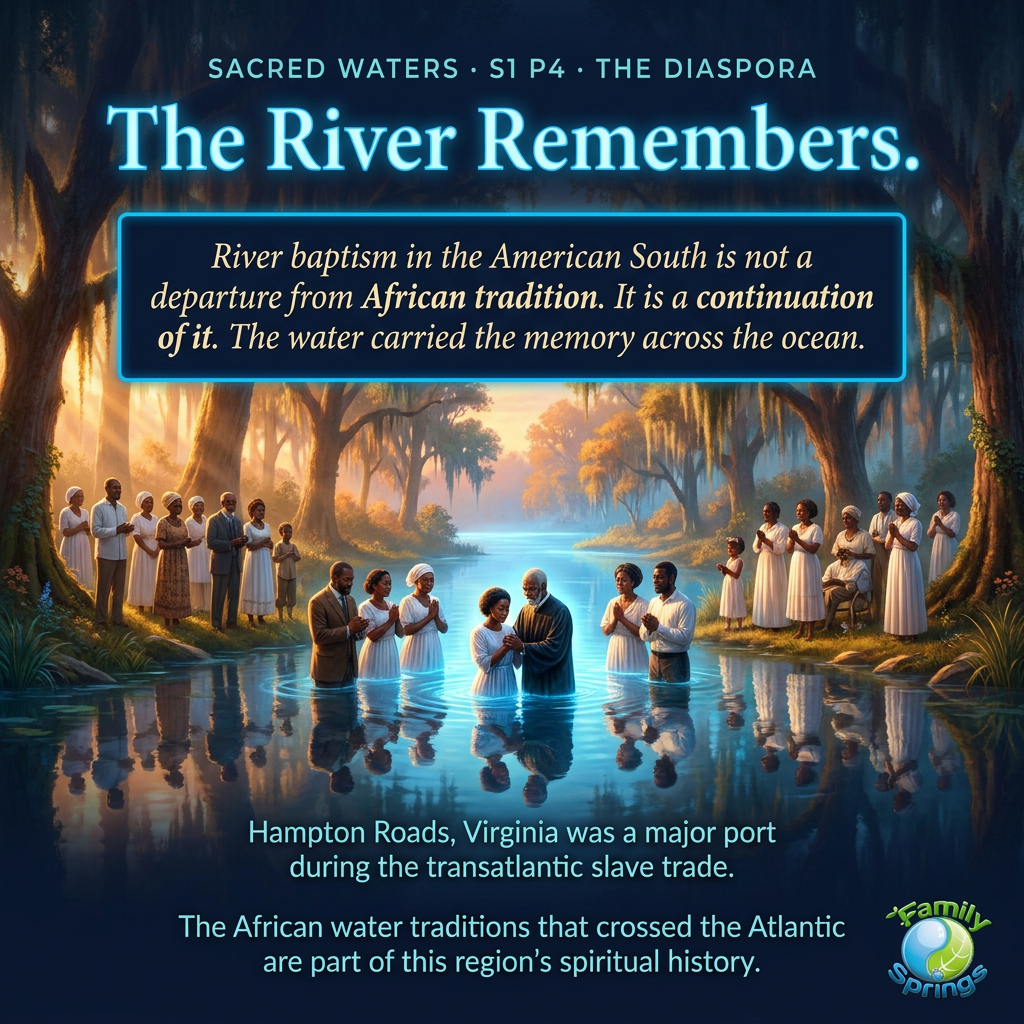
Hampton Roads, Virginia is a port city. That history includes the painful fact that it was one of the major points of entry for enslaved Africans brought to North America. The people who arrived through those waters brought their spiritual traditions with them, including their relationship with water.
River baptism in the American South is one of the most recognizable forms of Black American Christian practice. It is also, at its roots, deeply African. The idea that immersion in moving water can transform a person, purify them, mark a passage from one state of being to another, did not originate in the New Testament. It was already alive in West African spiritual practice before the first missionary arrived. [5]
"River baptism in the American South is not a departure from African tradition. It is a continuation of it."
Sacred WatersWhat the African diaspora did in the Americas was not simply adopt Christianity. They recognized in Christian water rites something familiar, something that resonated with what they already knew about water's power to heal, transform, and connect the living to the spiritual world. They carried that knowing with them, and they wove it into the new traditions they were building in a new land. The river remembered. The river still does.
The Water Remembers
We are a small company in Hampton Roads. We drive to a spring in West Virginia to collect water with care and bring it back to this community. We did not set out to participate in something ancient. But the traditions explored in this series suggest that anyone who handles water with attention and reverence is, in some small way, participating in something much older than themselves.
The water traditions carried across the Atlantic by the people who passed through Hampton Roads are woven into the spiritual fabric of this region. That history is not something to move past. It is something to acknowledge, to understand, and to carry with the same care we bring to everything else we do.
The water remembers. And in Hampton Roads, so do we.
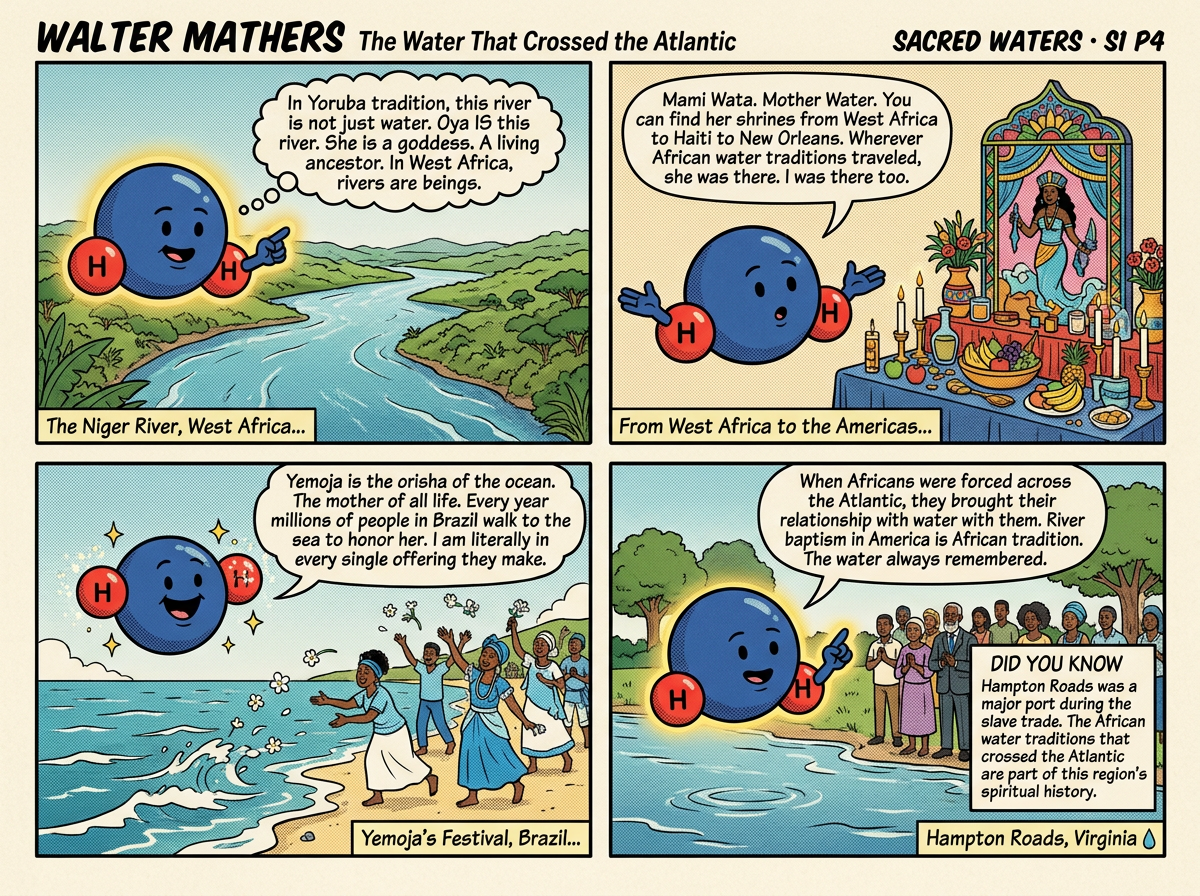

Walter Mathers says...
Oya is the Niger River. Mami Wata heals from West Africa to New Orleans. Yemoja is the mother of the ocean. The Nile rises from Isis's tears. And river baptism in Hampton Roads is African tradition still flowing. Water carries memory. I have been carrying it for a very long time.
Read the Full Sacred Waters Series
Each installment explores a different water tradition from around the world, from ancient Babylon to Indigenous North America to West Africa and beyond.
Read the SeriesSources
- Oya orisha, Yoruba tradition, and the Niger River: consensus.app/results/?q=Oya+orisha+Yoruba+Niger+River+water+tradition
- Mami Wata, African water spirit, healing tradition: consensus.app/results/?q=Mami+Wata+African+water+spirit+healing+tradition
- Yemoja, Yemanja, orisha, ocean, diaspora, Candomble, Santeria: consensus.app/results/?q=Yemoja+Yemanja+orisha+ocean+diaspora+Candomble+Santeria
- Nile flood, Egyptian mythology, Isis, Osiris, tears: consensus.app/results/?q=Nile+flood+Egyptian+mythology+Isis+Osiris+tears
- African diaspora, river baptism, water spirituality, America, Hampton Roads: consensus.app/results/?q=African+diaspora+river+baptism+water+spirituality+America+Hampton+Roads